A commercial pool that stays cold is not automatically suffering from an undersized heat pump. You will be able to separate circulation and control faults from heat-loss problems, calculate the duty for both temperature maintenance and cold-start recovery, and compare equipment on performance at your site rather than on a headline COP.
Key takeaways
- Check circulation, bypass valves, filters, and controls before replacing the heater.
- Size for both daily heat maintenance and recovery after pool covers are removed.
- Control evaporation because it drives major heat and indoor moisture losses.
- Compare COP at your site’s air and water temperatures, not brochure conditions.
Diagnose the cold pool before replacing the heater
A cold pool does not automatically mean the heater has failed. Check water movement and controls before testing the refrigeration circuit; a closed bypass or blocked filter can leave a sound commercial pool heat for pump system unable to deliver heat.
- Measure circulation flow at the heater inlet and outlet. Low flow points to a closed valve, undersized pump, clogged strainer or dirty filter.
- Inspect the bypass valve, isolation valves and air-release points. Air in the pipework can interrupt flow and trigger protection shutdowns.
- Compare controller, water and ambient sensor readings with calibrated thermometers. A faulty sensor can command standby or falsely report target temperature.
- Confirm setpoint, schedule, operating mode, defrost settings and any time-of-use lockout.
- Only then test refrigerant pressure, compressor operation, fan performance and the heat exchanger for fouling; use a qualified technician.
| Observation | Likely cause | Immediate check |
|---|---|---|
| Low flow or high filter pressure | Blocked filtration circuit | Clean filter and verify pump output |
| Normal flow but no temperature rise | Control or refrigerant fault | Check alarms, compressor and refrigerant circuit |
| Heater works while pool still cools | Heat loss exceeds input | Inspect cover use, wind, ventilation and cold makeup water |
If these checks pass, recalculate evaporation, convection, radiation, ventilation, ground losses and filtration losses. Pool volume alone cannot explain the required heating capacity.
Size the heat pump for maintenance and recovery
Separate two duties: maintenance capacity replaces heat lost during normal operation, while recovery capacity reheats the water within your specified time. Sizing only from pool volume will undersize a commercial swimming-pool heat pump during startup or after adding cold makeup water.
Calculate recovery energy as:
Pool volume (m³) × 1.163 × temperature rise (°C) = kWh
Divide that result by the available recovery hours, then add the ongoing heat-loss load. A 500 m³ pool rising 8°C needs 4,652 kWh; over 12 hours, the water-heating duty alone is 387.7 kW. Select output at the site’s actual winter air and water temperatures, not the supplier’s most favourable test point.
Calculate the maintenance load from:
- Evaporation from the water surface, with the cover open or closed
- Convection and long-wave radiation
- Outdoor air or ventilation losses
- Ground, structure and pipework losses
- Filtration and circulation-system losses
- Cold makeup water entering the pool
Use the minimum or seasonal design ambient temperature, wind exposure, surface area, target water temperature and cover schedule. A cover can reduce evaporation substantially, so state its use in every quotation.
Treat “commercial heat pump India” as a search term, not a specification. Require capacity, COP and electrical input at identical entering-air temperature, entering-water temperature, humidity, water flow and defrost assumptions. Add backup heating when cool nights or winter recovery exceed the air-source unit’s available runtime.
Control evaporation, temperature and indoor moisture losses
An uncovered pool loses heat mainly through evaporation, so a properly fitted automatic or floating cover can cut pool-heating energy use by roughly 50–70%. Specify whether the cover is on or off during each operating period; omitting that detail makes heat-pump capacity and running-cost comparisons unreliable.
- Cover the water whenever the pool is closed or unused. Remove the cover before admitting swimmers, and allow the heat pump to handle the uncovered operating load.
- Reduce air movement directly across the surface. Strong supply-air jets, fans and open doors increase evaporation even when the water temperature stays unchanged.
- Control indoor relative humidity with the ventilation or dehumidification system. Excess moisture increases latent load, causes condensation and adds electricity use; insufficient moisture removal damages the building.
Indoor pools have a separate latent-load problem: evaporation puts water vapour into the natatorium, and the air system must remove it. Raising the water temperature without adjusting air temperature, humidity and air movement can increase evaporation, erasing part of the expected heating saving.
Set the lowest water temperature that meets the facility’s health, therapy or user requirements. Higher temperature increases vapour pressure and heat loss. When comparing a swimming pool heat pump india quotation, require capacity and COP at the site’s design air and water temperatures, with the cover removed if that is the operating condition.
A “COP 6” at warm test conditions does not predict winter running cost.
Compare COP and heating options at real site conditions
Compare every option at the same entering-water temperature, outdoor condition, humidity, flow rate and operating schedule. A quoted COP 6 has no value if it applies to warm air while your pool operates on a cool night with the cover removed.
| Option | Real-site comparison | Best decision basis |
|---|---|---|
| Heat pump | COP and heating capacity fall as outdoor air cools; defrost and circulation pumps add consumption. | Require kW heat output and COP at the design air and water temperatures, plus backup capacity. |
| Gas boiler | Compare useful heat after combustion and flue losses, not COP. Fuel storage, ventilation and emissions add scope. | Use where rapid recovery or cold-weather backup matters and gas supply is reliable. |
| Electric resistance | COP is 1: one kilowatt-hour of electricity produces about one kilowatt-hour of heat. | Consider only where the tariff, electrical service and required capacity remain acceptable. |
| Solar thermal | Output follows sunlight and collector temperature; it cannot guarantee night-time or cloudy-day heating without storage or backup. | Compare annual useful heat, roof area, storage and backup runtime. |
| Waste heat | The heat source may be low-cost, but exchangers, pumps, controls and availability determine delivered heat. | Use only when the source temperature, flow and operating hours match pool demand. |
Ask each supplier to include auxiliary electricity, startup current, pumps and defrost in the comparison. The phrase commercial heat pump india is not a performance specification; require a real load test at the site design condition and state the supplementary source for winter operation.
Examine energy tariff, fuel escalation, maintenance, noise and service response alongside COP.
Write a specification that survives Indian operating conditions
Approve the equipment only against a site-specific performance schedule, not an unqualified “COP 6” or “COP 7” claim. Require the supplier to state capacity and COP at the same entering-air temperature, entering-water temperature, relative humidity, water flow, defrost assumption and auxiliary power for every tender.
1. Record the electrical and design conditions: supply voltage, frequency, phase arrangement, maximum current, minimum and maximum ambient temperature, pool-water setpoint, required heating capacity, and whether the figure maintains temperature or includes cold-pool recovery.
2. State the pool chemistry limits in writing: pH, free chlorine, salt concentration, total dissolved solids and maximum water temperature. Require titanium or equivalent corrosion-resistant wetted components, sacrificial protection where specified, and isolation details for chemical dosing equipment.
3. Require a sound-pressure limit in dB(A), the measurement distance and the operating condition. Reject catalogues that provide only sound power, because multiple outdoor units near hotel rooms or a courtyard can create a serious nuisance.
4. Include the cover status and backup source in the load schedule. State whether the cover is on or removed during operating hours, then identify electric, gas, solar-assisted or hydronic backup for cool nights.
5. Put service obligations into the contract: warranty response time, local technicians, refrigerant recovery and charging capability, and stocked compressors, controllers, sensors, fans and heat exchangers. A swimming pool heat pump India listing proves none of these.
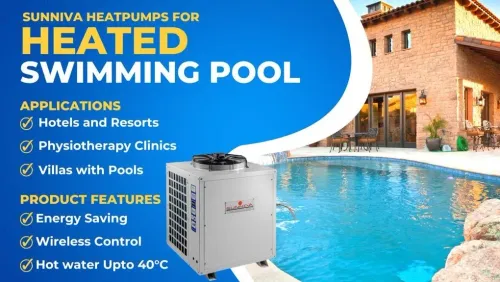
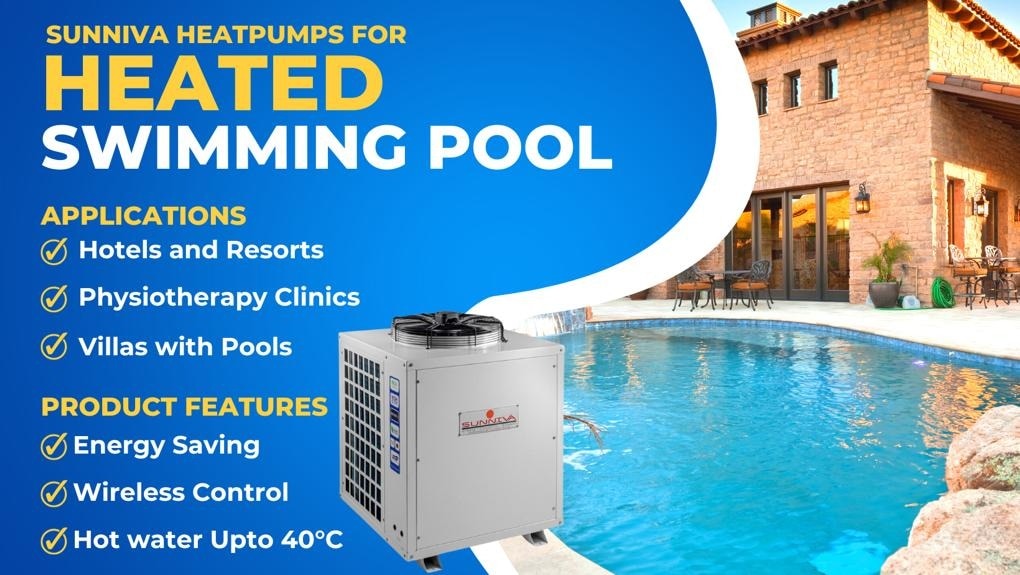
A swimming pool heat pump manufacturer India search should therefore become a verification checklist. Ask SUNNIVA HEAT PUMPS to quote the same operating points and document local parts support before comparing price.
Related product
Frequently asked questions
What should you check before replacing a commercial pool heat pump?
Check water circulation, filter pressure, bypass and isolation valves, flow switches, temperature sensors, setpoints, and electrical alarms before testing the refrigeration circuit.
How do you size a heat pump for commercial pool heating?
Calculate heat loss from evaporation, convection, radiation, plumbing, and fresh make-up water, then add the recovery load required to restore temperature after covers are removed.
How can a facility reduce swimming pool heat and moisture losses?
Use a properly fitted pool cover when the pool is idle, control indoor air temperature and humidity, limit uncontrolled outdoor-air intake, and maintain suitable water circulation.
How should you compare commercial pool heat pumps in India?
Compare heating output and COP at the site’s design air and water temperatures, along with defrost behaviour, flow requirements, corrosion protection, service access, and local operating conditions.
Related product
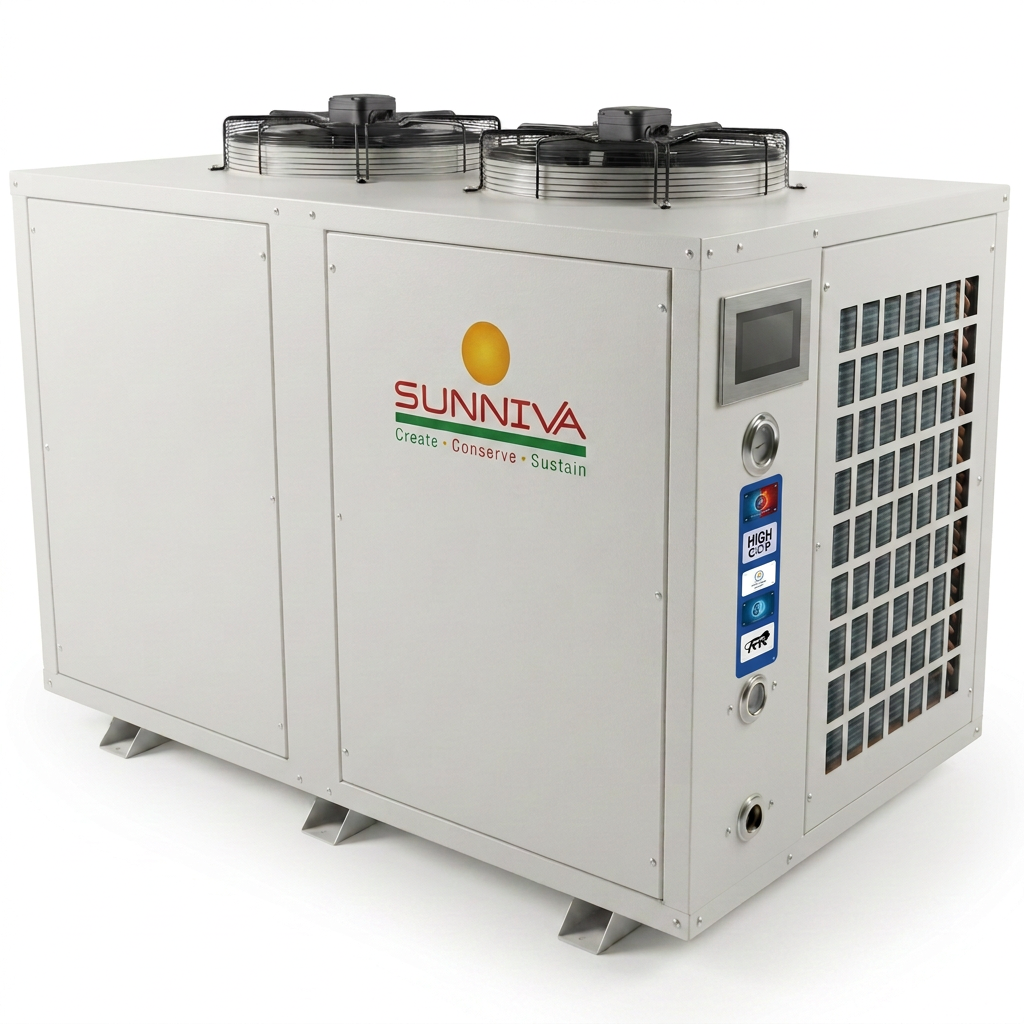 | Swimming Pool Heat Pump ₹400000 How it works Pool water is drawn through a filter and circulation pump, passed through the heat pump's titanium condenser where it picks up heat... View product → |