The label “commercial” does not tell you whether a heat pump suits your pool. You need to compare design heat loss, operating schedule, water chemistry, electrical requirements, performance at Indian conditions, and the cost of keeping the pool open during maintenance before choosing a unit or system arrangement.
Key takeaways
- Size the heat pump from heat loss, target temperature and usage, not pool volume alone.
- Compare COP at the same air, water and humidity conditions.
- Specify titanium exchangers for chemically treated pool water.
- Demand staged capacity, remote controls, service access and backup planning for commercial pools.
What separates a swimming pool heat pump from a commercial pool heat pump?
India and commercial describe different things: India identifies the installation location and climate; commercial identifies duty, controls, serviceability, water-treatment exposure, and redundancy. A swimming pool heat pump India comparison must therefore use operating conditions, not the largest catalogue unit. The phrase swimming pool heat for pump india describes a search need, not a technical category.
| Term | Meaning | Selection consequence |
|---|---|---|
| India | Equipment intended for Indian climate and site conditions | Check ambient range, corrosion protection, electrical supply, and drainage |
| Commercial | Equipment for sustained, controlled operation | Check water chemistry limits, flow proving, service access, sequencing, and redundancy |
A commercial pool heat pump might be one larger unit, several units operating in parallel, or a central hot-water heat pump adapted to pool heating through a heat exchanger. Parallel units improve part-load operation and allow maintenance without total shutdown; one unit costs less to coordinate but leaves no heating capacity during service.
Choose the arrangement after recording:
- Home pool: volume, surface area, target temperature, cover use, and desired heat-up time.
- Apartment, school, or gym: operating hours, peak demand, and whether classes continue during maintenance.
- Hotel or resort: multiple pools, seasonal schedules, water-treatment exposure, and acceptable downtime.
- Public pool: long operating hours, rapid recovery, duty/standby capacity, and controls linked to filtration.
An uncovered, high-use pool needs more capacity than a covered pool with the same volume. Define whether a shutdown is acceptable before choosing one large machine or staged modules.
How do you size a pool heating heat pump instead of guessing from pool volume?
Size a pool heating heat pump from total heat loss, not pool volume alone: evaporation, transmission to ambient air, ground or structural losses, and makeup-water losses. For an uncovered outdoor pool, evaporation is usually the largest component, and wind exposure increases it sharply.
Specify these inputs before requesting capacity:
- Pool volume and water-surface area
- Target pool-water temperature and outdoor design temperature
- Wind exposure and expected humidity
- Cover type and daily cover hours
- Required heat-up time
- Operating schedule, including hours open and setback periods
An uncovered, wind-exposed pool therefore needs a different capacity from a covered pool of identical volume. A thermal cover can reduce the energy needed to heat a swimming pool by 50%–70%, according to the U.S. Department of Energy.
Compare both options using the same cover assumptions; otherwise the larger machine may only be compensating for avoidable evaporation.
Do not accept a catalogue kW figure as usable output. Request heating capacity, input power, and COP at the actual entering-air temperature and pool-water temperature, because air-source output falls as outdoor air gets colder or required water temperature rises.
For a swimming pool heat pump India comparison, ask the supplier to state whether the figures follow AHRI 1160 or another named rating method, and whether defrost power is included.
Use the design heat loss plus the required heat-up load and operating schedule to select capacity. A commercial pool heat pump that runs long hours needs documented performance at those conditions, not merely a larger nominal rating.
Which performance figures and heating technologies are genuinely comparable?
A genuinely fair comparison uses identical conditions. An air-source pool heating system, whether sold as a swimming pool heat pump India solution or a commercial pool heat pump, should be judged by duty and measured output, not headline COP alone.
| Technology | Installation | Speed, cost and emissions | Weather and backup |
|---|---|---|---|
| Air-source heat pump | Outdoor unit, water connections, drainage and defrost | Lower running cost than resistance; moderate heat-up; emissions depend on electricity | Weather-dependent; retain backup for cold peaks or rapid recovery |
| Electric resistance heater | Simple electrical installation with high supply capacity | Fastest heat-up; high operating cost and indirect emissions | Weather-independent; often useful as backup |
| Gas or diesel boiler | Fuel storage, flue, combustion controls and safety systems | Fast heat-up; fuel and maintenance costs; direct emissions | Weather-independent; useful backup |
| Solar thermal | Collectors, pumps, controls and substantial area | Low running emissions; slow heat-up and low operating cost | Sun-dependent; requires backup |
| Geothermal or water-source heat pump | Boreholes or source-water loops, pumps and permits | Stable, efficient operation; high installation complexity and low operating emissions | Less weather-sensitive; backup covers maintenance |
Request heating capacity in kW, input power, COP, water-flow range, pressure drop, sound-power level, minimum operating temperature, defrost method, refrigerant, and output at realistic Indian air-and-water conditions. Compare those figures at identical entering-air and pool-water temperatures under AHRI 1160, or a clearly stated equivalent, and confirm whether defrost power is included.
Capacity and COP fall as air gets colder or pool water gets hotter; humidity can increase defrost demand. Model seasonal compressor, circulation-pump, defrost and standby energy, tariff, cover use, and backup operation—not rated COP alone.
What changes when the pool operates in India or inside a commercial building?
India adds monsoon humidity, dust, hard water, and coastal corrosion; a commercial building adds tighter drainage, access, and electrical constraints. Mumbai’s salt air attacks outdoor coils, while chlorine, bromine, and salt water attack the pool heat exchanger. Blocked drains leave condensate around the unit, and inadequate service clearances turn routine coil cleaning into a shutdown.
| Condition | Design check | Failure if missed |
|---|---|---|
| Outdoor monsoon | Confirm condensate drainage, coil defrost, frost control, and coil-cleaning access | Water damage, icing, or falling capacity |
| Mumbai coastal site | Specify corrosion protection for the outdoor coil and cabinet | Premature corrosion from salt air |
| Indoor commercial pool | Separate water heating from ventilation and dehumidification | Condensation damages glazing, structure, and equipment |
| Therapy pool or spa | Recheck capacity and COP at the higher leaving-water temperature | An ordinary 26–28°C rating overstates performance |
For a swimming pool heat pump India comparison, obtain these items in writing before comparing a commercial pool heat pump:
- Maximum chlorine and bromine concentration, pH range, salt limit, heat-exchanger material, allowable water flow, and pressure drop.
- Heating capacity, input power, and COP at actual air and water temperatures, plus defrost power and operating ambient range.
- Voltage, phase, protection, drainage, service clearances, refrigerant type and charge. A2L or A3 refrigerants trigger additional leak, ventilation, ignition-control, and installation checks.
How should you compare suppliers and configure a commercial pool system?
Ask suppliers for a site-specific design, not a catalogue kW figure. A useful swimming pool heat pump India comparison requires capacity, input power, and COP at the same two realistic air-and-water conditions, plus lifecycle electricity, circulation, defrost, backup, and maintenance costs.
| Option | Strength | Control requirement |
|---|---|---|
| Staged modules | Efficient partial-load operation and capacity matching | Sequencing, common headers, isolation valves, flow proving, bypass design, and pump interlocks |
| Duty/standby units | Heating continues while one unit is serviced | Automatic changeover, equal run hours, and independent isolation |
| One oversized unit | Simpler plant layout | Poorer part-load efficiency and total shutdown during maintenance |
Use staged or duty/standby capacity when operating load varies, shutdown is unacceptable, or the pool has long daily hours. Prevent short cycling with coordinated sequencing and verify each module’s minimum flow; an oversized machine does not solve weak hydraulics. Include a backup boiler or resistance heater where rapid heat-up, extreme weather, or uninterrupted operation matters.
Your tender schedule should request:
- Ambient operating range, maximum water temperature, water-flow range, pressure drop, sound-power level, and defrost behaviour.
- Refrigerant type and charge, electrical phase and protection, service clearances, and warranty exclusions.
- Water-chemistry limits, including pH and chlorine or salt concentration.
Check the heat pump against filtration pumps and treatment equipment. SUNNIVA HEAT PUMPS should be asked for this documented site design when comparing a pool heating heat pump, not simply its highest published rating.
Related products
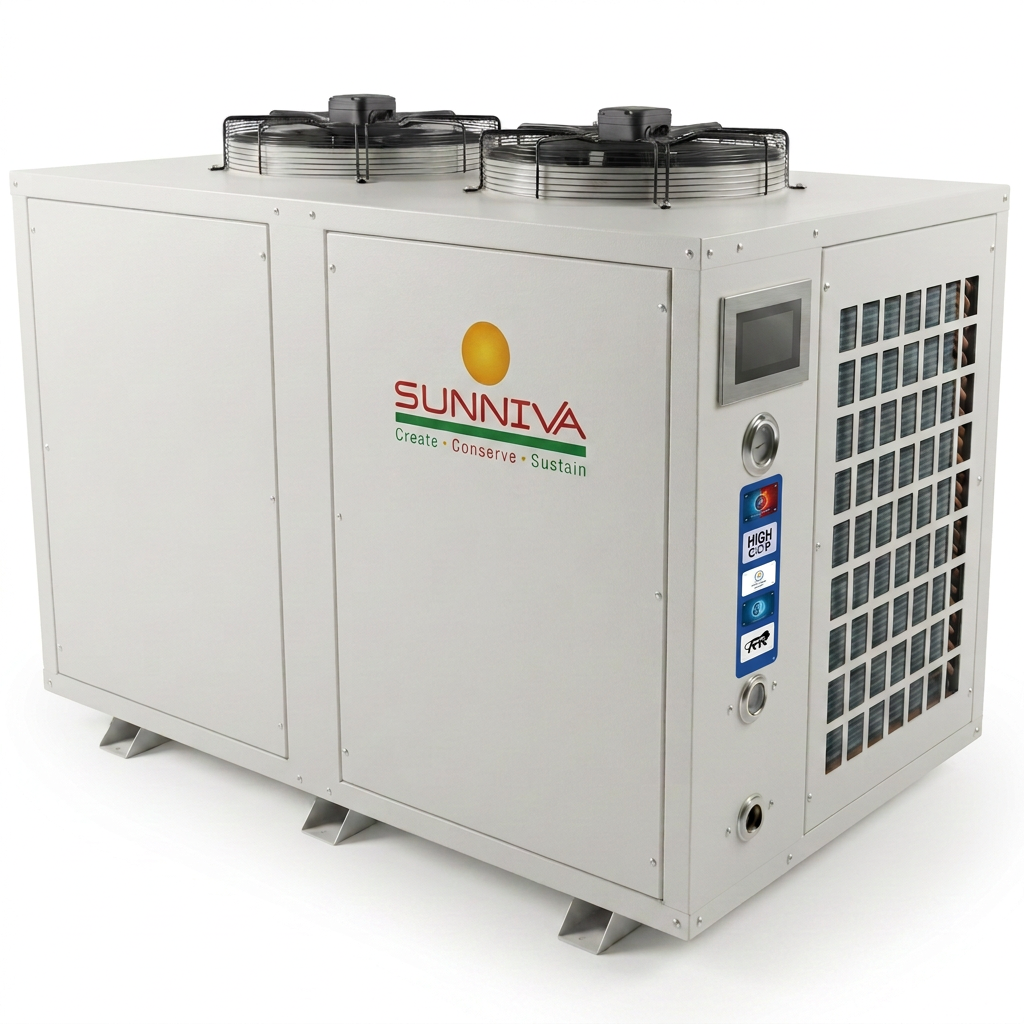 | Swimming Pool Heat Pump ₹400000 How it works Pool water is drawn through a filter and circulation pump, passed through the heat pump's titanium condenser where it picks up heat... View product → |
 | Commercial Heat Pumps ₹500000 Commercial Heatpumps How it works This series serves centralised hot water systems where a large storage tank feeds multiple outlets. View product → |
Frequently asked questions
What separates a swimming pool heat pump from a commercial pool heat pump?
A commercial pool heat pump is selected for duty cycle, water-treatment exposure, controls, serviceability and redundancy rather than location alone. A residential unit may lack the capacity, staging and monitoring needed for continuous commercial operation.
How do you size a pool heating heat pump instead of guessing from pool volume?
Calculate heat loss from evaporation, ambient air, wind, pool surface, target water temperature and operating hours. Add the recovery load after covers are removed, then select capacity for the design conditions.
Which performance figures and heating technologies are genuinely comparable?
Compare heating capacity and COP at identical entering water temperature, outdoor air temperature and humidity. Check whether the unit uses air-source or another technology, its operating range, defrost method and output at colder conditions.
What changes when a pool operates in India or inside a commercial building?
Use local outdoor design conditions, monsoon humidity, electricity supply and water-treatment practices for an Indian installation. Indoor commercial pools also require ventilation and dehumidification coordination because evaporation drives both heating load and building moisture.
How should you compare suppliers and configure a commercial pool system?
Request a heat-loss calculation, test conditions, exchanger material, controls sequence, maintenance access, warranty terms, spare-parts plan and staged or standby capacity. Confirm integration with filtration, chemical dosing, ventilation and building controls.